
Transcript
Dr. Turck:
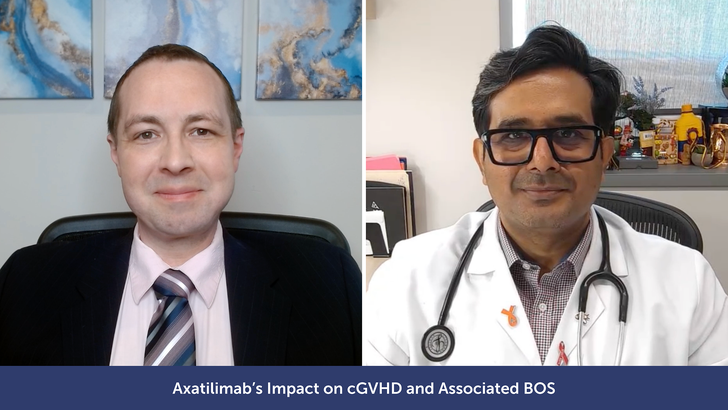
This is Project Oncology on ReachMD, and I'm Dr. Charles Turck. Joining me today is Dr. Amandeep Salhotra, who's an Associate Professor in the Department of Hematology and Hematopoietic Cell Transplantation at City of Hope in Duarte, California. Together, we'll be reviewing the findings from a recent analysis evaluating the impact of axatilimab on patients with chronic graft-versus-host disease, or GVHD for short, and associated bronchiolitis obliterans syndrome, or BOS. These data were presented at the 2026 TANDEM Meeting. Dr. Salhotra, welcome to the program.
Dr. Salhotra:
Thank you so much for the kind invitation, Dr. Turck.
Dr. Turck:
Starting with some background on this analysis, investigators pooled data from 117 patients across two studies to better understand outcomes with axatilimab among patients with chronic GVHD and BOS. So if we look at the big picture here, Dr. Salhotra, why was it important to conduct this analysis, and what aspects of the study design make it valuable?
Dr. Salhotra:
So bronchiolitis obliterans syndrome or lung graft-versus-host disease occurs in approximately 10 to 15 percent of the patients who eventually develop graft-versus-host disease. It's a particularly difficult form of graft-versus-host disease to treat because of the lack of efficacy of approved agents in this setting.
Fortunately, in the AGAVE-201 study, which was the pivotal phase two multicenter trial, approximately 40 percent of the patients did have lung GVHD at baseline. So this was a good study to look at the response rates in patients with lung GVHD who are on trial.
So the primary outcome was overall response rates after six cycles of treatment. So we did the baseline assessments—clinical and patient-reported outcomes at cycle one, day one. And six months later on cycle seven, day one, the assessments were done. So there were objective physician-reported outcomes and patient-reported outcomes that the study reported upon.
Dr. Turck:
Turning to the results, among the 117 patients who received axatilimab, the overall NIH lung-specific response rate was 38.5 percent with a median time to first response of 2.6 months. How do you interpret these efficacy outcomes, especially in the context of the larger treatment landscape for pulmonary chronic GVHD?
Dr. Salhotra:
So I would say these results are very encouraging, and I say that because patients who were enrolled in AGAVE-201 had very advanced disease. Most of them—I would say the majority of them, 80 percent—had severe chronic graft-versus-host disease. The majority of them had multi-organ involvement, and they had progressed through multiple prior lines of treatment.
The other point that I would make is that patients with more advanced form of lung GVHD were allowed to enroll on the study, and this was a subset of patients who were excluded from prior trials. So the fact that we are seeing these high objective response rates in patients with more advanced form of lung GVHD is very encouraging, and it's helpful for our patients with lung GVHD who have limited treatment options at this point in time.
The median time to response in the overall population was approximately 1.5 months. Now, it's important to note that in lung GVHD, response rates are a little bit delayed—2.3 months in a median, and some patients responded a little bit later. So when I start the medication or this IV formulation, I give patients a heads up that they should not anticipate quick results. They have to stick to the program and give it at least two to three months before improvement in clinical symptoms or FEV1 criteria is noted.
Dr. Turck:
Now, another notable finding was that lung responses were observed regardless of baseline disease severity. In fact, patients with the most severe lung impairment achieved a lung response rate of 40.5 percent, which was comparable to patients with less severe impairment. What does that tell us about the potential role of axatilimab across the spectrum of pulmonary involvement?
Dr. Salhotra:
That's an important point that you bring up, Dr. Turck. So we classify the severity of chronic graft-versus-host disease of the lung based on the FEV1 score. So anything less than 39 percent classifies as a score three or severe BOS or lung GVHD. Now, almost 40 percent of the patients with lung GVHD had severe lung involvement defined by FEV1 of less than 39 percent, and we see responses even in these patients who had more advanced forms of lung disease, either by FEV1 or by symptom scores.
So the fact that patients with these advanced lung GVHD are responding to axatilimab is very important, meaning that patients with more advanced disease can also respond to treatment.
Dr. Turck:
Now, the analysis also evaluated outcomes according to symptom burden and found that patients with an NIH lung score of 3 achieved response rates comparable to those with less severe symptoms, although complete responses were observed more frequently in patients with milder disease. That being said, would you tell us how you view the relationship between disease severity and the likelihood of achieving meaningful clinical improvement?
Dr. Salhotra:
An important part of our disease assessment is the physician-reported scores, but patient-reported outcomes are very important as well. So traditionally, we've used the Lee Symptom Score. It looks at various domains and quantifies the symptom burden in patients. So that's something that was quantified in this study as well. So every month when the patients came in for their response assessments, we looked at the symptom burden.
And fortunately, among patients with high symptom burden either at rest or at exercise, all of them responded to treatment in a positive way. So there was less shortness of breath. There was improvement in the patient-reported outcomes both at rest and with exercise, indicating that there was improvement in quality of life, not only as perceived by the physicians on the objective criteria, but also subjectively by the patients, which is important. Quality of life and how patients feel on treatment is very important.
Dr. Turck:
For those just joining us, this is Project Oncology on ReachMD. I'm Dr. Charles Turck, and I'm speaking with Dr. Amandeep Salhotra about the clinical outcomes associated with axatilimab in chronic graft-versus-host disease, or GVHD, and bronchiolitis obliterans syndrome, or BOS.
So beyond investigator-assessed responses, the study also looked at objective pulmonary function outcomes. Among the 75 patients evaluable for change in FEV1, just shy of a third experienced at least a 5 percent absolute improvement, and a fifth achieved at least a 10 percent improvement from baseline. From your perspective, Dr. Salhotra, how meaningful are these changes in lung function for patients living with this disease?
Dr. Salhotra:
So we think of bronchiolitis obliterans as a fibrotic manifestation, and we think of it as the last phase of chronic GVHD pathogenesis. So there's an early phase that is a cytokine storm. There's a chronic inflammation phase where the T cells are activated, and then the final phase is when there is layering of the collagen and fibrotic manifestation.
So the fact that patients are not only stabilizing their FEV1s, but there is improvement in the FEV1 in some patients by 5 percent and other patients by almost 10 percent, that's definitely something which helps improve their quality of life. And it's really something that we have not seen in the past. Actually, some of these studies using these novel agents exclude patients with severe lung GVHD. So the fact that we are seeing improvement not only in the symptom scores, but improvement in the FEV1 scores by 5 to 10 percent is something that is really helpful for our patient population.
Dr. Turck:
Another key observation was that there were improvements in shortness of breath even in some patients who did not meet formal NIH lung response criteria. What impact might that have had on the way we view the relationship between traditional response measures and what patients actually experience in their daily lives?
Dr. Salhotra:
So one of the drawbacks of the NIH consensus criteria is that sometimes, patients have a clinical improvement, but that's not captured on the NIH scale. As we just previously alluded to, we look at FEV1 improvement either by 5 or 10 percent to quantify that as a clinical response.
The important finding that we had is that in the studies, even if the patients do not have an NIH response—at least on the patient-reported scores—their quality of life scores are improving, so they feel less shortness of breath at rest and at exercise, and that was captured on the patient-reported outcomes. So again, even if you don't see an objective improvement in the FEV1, if the patient-reported scores are improving, that does improve quality of life of these patients and is an important endpoint that we use to assess the efficacy of the drug.
Dr. Turck:
And just to bring this all together before we close, Dr. Salhotra, the investigators found no significant associations between baseline characteristics and the likelihood of lung response, suggesting that a broad range of patients may benefit from treatment. But at the same time, grade three or higher respiratory infections occurred more frequently among patients with pulmonary involvement. So as you reflect on these findings, what are the most important clinical takeaways from this analysis?
Dr. Salhotra:
The bronchiolitis obliterans form of chronic graft-versus-host disease is a particularly difficult form of GVHD. It occurs in a minority of the patients who eventually develop GVHD, but those who develop BOS tend to have disproportionate morbidity and mortality.
So far, the medications or the drugs that we have available or those that are FDA approved are associated with response rates of around 30 percent or so. The benefit of axatilimab is it leads to improvement not only in patients with more advanced form of lung GVHD with a lung score of three—meaning FEV1 scores of less than 39 percent—but these responses are associated with actual improvement in patient-reported outcomes and, in some cases, improvement in FEV1 by 5 or 10 percent. Even the patients in which we do not see improvement in FEV1, at least the patient-reported scores are improving.
You're correct in your assessment that infections were higher in patients with lung GVHD, and that's, I would say, the patient population that comes into the trials with GVHD. Most of these patients are on corticosteroids, they're on inhaled agents, and they're immunocompromised. So we do anticipate them to have higher rates of infections. Approximately 22 percent of the patients had lung infections. This could be bacterial, viral, or fungal infections. And it's important that these patients receive adequate prophylaxis, and if they report symptoms of shortness of breath or cough which is worsening, they need to be investigated thoroughly for infectious complications and then treated appropriately. I would emphasize that these patients need to be on prophylactic antimicrobials. They need to be vaccinated for seasonal flu and COVID. The study was done during the COVID period, so we did see COVID pneumonias in a majority of the patients who were on study.
Dr. Turck:
Well, with those final thoughts in mind, I want to thank my guest, Dr. Amandeep Salhotra, for joining me to discuss these clinical data so that we can better understand treatment response and outcomes in patients with pulmonary chronic graft-versus-host disease. Dr. Salhotra, it was great having you on the program.
Dr. Salhotra:
Thank you, Dr. Turck.
Dr. Turck:
For ReachMD, I'm Dr. Charles Turck. To access this and other episodes in our series, visit Project Oncology on ReachMD.com, where you can Be Part of the Knowledge. Thanks for listening!

